

 Collections
 Poker1 library
Note: Not at the old Poker1 site. A version of this entry was originally published (2010) in Bluff magazine.
When I’m typing a column full speed, forcing my fingers to keep pace with my thoughts, I sometimes look back at a sentence in shock. Warnings blast through my brain: “That doesn’t make sense,” or “The point would be more powerful if you said it another way.”
This prompts on-the-fly revision and I merely delete the sentence and start over or wiggle words around. I still remember how tedious those edits were on a typewriter and appreciate how greatly computers have enhanced the creative experience.
Where it goes
Where is this leading? I’m not sure yet, but let’s see where it goes.
Here’s the thing: We can’t make revisions to actions we’ve taken, even if they’re embarrassing. If we regret having done something, it can’t be undone. All we can do is leave it in life’s manuscript and try to repair it afterward.
Poker is like that, too. Once we’ve made a mistake, it’s history. It can’t be deleted or modified. The best policy in poker or life is to not repeat that mistake a second time. We can’t edit the first one.
The lady and the fly
I remember sitting at a poker table years ago next to a very professionally dressed woman who was cute as a bug – which, by the way, is a famous expression I never understood. I keep it in my mysterious English wordings file along with “Don’t throw the baby out with the bathwater.” I never could identify with that one. I mean, why not throw the baby out with the bathwater?
Anyway, I really wanted to date this woman and, being a chameleon by nature, switched into my most sophisticated persona. I left briefly to visit the men’s room.
Upon my return, the woman leaned over and informed me discreetly, “Your fly is wide open.”
Slightly humiliated, I blurted, “I do that on purpose. It changes my luck.”
No date
And I didn’t zip up immediately. I never got the date, maybe because that spur-of-the-moment decision about how to handle the situation was too bizarre. I immediately wished I could rewrite the script, but history is history.
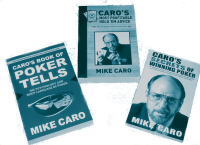
This takes us to the topic of poker tells. About 26 years ago I wrote Caro’s Book of Tells – The Body Language of Poker. And I guess that answers the question: “Where is this leading?”
All the tells included in that book were beyond debate. You can scour the web and see very little argument about them. I left out any tells that were controversial or uncertain. Players immediately knew that these tells were legitimate when they read the book, because they themselves had the inclination to do the very same things.
I, too, had that same inclination and had caught myself doing them. That was a major contribution to my research. I’d find myself broadcasting a tell, corrected it, and then watched amazed to see so many other players reacting the same way in similar situations.
Four tells
Here are four selected tells you can believe in.
- When players buy into a game in a low-key manner, hiding their money, you can expect them to play conservatively. Conversely, if they flash their money, calling for chips with a flair, they’ll usually play recklessly.
When you use this knowledge against players you’ve never encountered before, you get a profitable head start. Unless subsequent events make you revise this first impression, call less often and bluff more often against the player who hid his money; call more often and bluff less often against the player who bought in conspicuously.
This tell won’t be 100 percent accurate, but it’s right most of the time. And that gives you an instant advantage against unknown opponents.
- Players who look at their cards and then gaze away from the action are usually intending to bet or raise. They have strong hands.
That wayward gaze falls somewhere between an act and instinctive behavior. That opponent is deliberately trying to seem uninterested and, for you, this usually means trouble!
- Any seemingly disgusted or reluctant wager means a strong hand. The player is trying to convey uncertainty about the bet.
But if it actually were a weak hand, that opponent would do everything possible to disguise the fact. Unless you hold a very strong hand, you should usually fold when an opponent seems unsure or hesitant about betting.
- When it’s your turn to act, if opponents are slightly reaching toward their chips or even moving their hands almost imperceptibly in that direction, they’re trying to discourage your bet. This gives you the opportunity to profitably bet medium-strong hands you might otherwise have checked.
Caution
Here’s a closing bit of caution. Few things are certain in life or in poker. Don’t expect to be perfectly accurate when you use poker tells. They have power, but not absolute power. So, it’s usually a mistake to rely solely on a tell when other factors heavily favor of a contrary decision.
If the tell seems weak, use it as a tie-breaker for borderline decisions. That gives you a long-term edge.
Occasionally, you’ll encounter a very compelling tell that will override everything else. But that’s rare. The correct method is to include the tell in your decision-making equation, while seldom using it alone to dictate your action.
You can sacrifice a lot of money if you ignore tells; but you can also sacrifice a lot of money if you let them govern your decisions totally. You’ve been warned. — MC