



 Collections
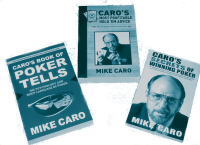 Poker1 library

Note: Not at the old Poker1 site. A version of this entry was originally published (1999) in The Gambler magazine.
True story. It’s 1981. The game is ace-to-five lowball, a form of poker where you try to get the lowest ranking cards you can without a pair. We’re at the Eldorado Club in Gardena, California. Owner George Anthony is playing. So is Bruce or Butch or Bosco — can’t remember his name. It started with a B, so let’s settle on Boris and be done with it. Boris was another waning hippie who showed up and played the big game for about a week, then vanished without a trace. Vanished without repaying my $500, too, but that’s another story.
I’m in a pot with Boris. We each draw one card. Me, I make 9-8-4-3-A — a medium good, but vulnerable, hand. As I’m checking, I feel a rush of warm breath on my shoulder. I’m studying my opponent, so I don’t bother to turn around. But I remember hoping that this is pretty-young-woman breath and not pesty-male-poker breath. Boris turns over a pair of fives, losing the showdown.
A mumbling male
Warm breath comes nearer. There is a gust in my ear, accompanied by a male mumble: “How come you checked that hand? Aren’t you supposed to bet for value?” Betting “for value” — the way I mean it — simply means wagering aggressively when you have a risky hand with a slight edge. “I checked because Boris never bluffs,” I whispered.
“Never bluffs!” the student muttered. “That doesn’t make any sense. How can some guy never bluffing keep you from value betting? How can you be scared of a guy who doesn’t bluff?”
Well, can you guess how I feel about giving instruction at the table? I try to avoid it. So I motioned the student away. And then — far away from the ears of my foes — I explained this to him…
The more often they fumble, the more often you should punt
If I were teaching football strategy, I would point out that NFL professional teams punt too often (although they don’t now as often as they used to). In United States style football, anytime you see a team that has crossed the fifty-yard line punt on 4th down with less than two yards to go, there’s an excellent probability that you witnessed a mistake. Punting is simply kicking the ball voluntarily to your opponents, so that they can take control farther down the field.
When you punt, you surrender your initiative and give the ball to your opponent. This is similar to checking in poker. When it’s a close football decision between punting and running an offensive play in hopes of making a 1st down, you should consider how likely the opposing team is to fumble if given the ball.
The more likely, the better it is to punt. Punting gives them the opportunity to make those mistakes they’re inclined to make.
Give them opportunities to make mistakes
Same in poker. Checking can often give opponents opportunities to make mistakes. Never bluffing IS a mistake! Strategy indicates that you must bluff a certain percent of the time for every situation. If an opponent bluffs that percent, you have a very tough decision about whether or not to call. Mathematically, in fact, it doesn’t matter. Your profit expectation on each decision will be identical whether you call or fold. (Let’s not get into that today, though.)
If an opponent never bluffs, you gain something. Gain what.? You gain the advantage of never having to call for fear that you’re being bluffed. Okay. So, if an opponent never bluffs, it’s correct to sometimes sacrifice a value bet and check instead.
What if the opponent bluffs too much? Depends. If the opponent bluffs so often that you actually win more than half the time, obviously you should consider checking and calling. But even if your opponent errs by bluffing slightly too much, you might find a check more beneficial than a value bet. It’s worth a lot of money if you keep this concept in mind. — MC