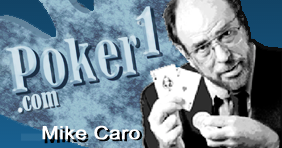


Note: Not at the old Poker1 site. This 39-part series of quizzes, originally published (2004-2006) in Poker Player, is based on the Mike Caro University of Poker library of research and advice. In each entry, Mike Caro presents 10 questions covering a category of poker, targeted for beginner, intermediate, or advanced players. Answers with explanations appear below each quiz, with the questions repeated for easy reference.
The MCU Targeted Poker Quiz series
(See the index to this series)
Psychology (level: intermediate)
- At MCU, we teach that most weak opponents often seem to call…
(a) oddly, primarily with black cards;
(b) anything that moves;
(c) often, but almost seldom twice in a row;
(d) less often than they should.
- It’s psychologically satisfying to maintain a long winning streak. Which statement about such a streak is most true?
(a) It’s important to try to keep the streak alive as long as you can afford to do so;
(b) You might be losing money overall by extending a winning streak;
(c) The more days in a row you win, the more days in a row you’ll probably lose in the future;
(d) Players who have the longest winning streaks are, on average, poker’s biggest lifetime winners.
- Caro’s Threshold of Misery states that…
(a) You stop feeling any more pain once you’ve lost more than you expected was likely – and this can put you in a dangerous situation;
(b) Everyone has a different tolerance for losing, and you should develop as great a tolerance as possible;
(c) Players typically get irritated if they win too many hands in a row – thus, misery applies equally to winners and to losers;
(d) There’s no way to keep an even disposition at poker, and trying to do so will always cause you to lose in the long run.
- If you feel that you’re being cheated…
(a) you’re apt to be wrong, but the feeling itself can cause you to lose;
(b) you probably won’t be able to concentrate fully on making the best decisions;
(c) you should often leave the game, even without proof;
(d) all of the above.
- It’s often profitable to seem like a maniac in poker, especially if…
(a) you’re a “friendly” maniac;
(b) you can avoid being caught up in the act and playing poorly;
(c) your opponents are paying attention;
(d) all of the above.
- Most players seem to take turns going on tilt.
(a) True;
(b) False.
- If you say, “I think I have a straight flush, but maybe I’m bluffing,” you’ve given your opponent an “either-or decision.” This can be effective psychology if…
(a) you’re bluffing;
(b) you have a weak hand with vague hopes of winning, but don’t want a call;
(c) you’ve been losing consistently for at least an hour;
(d) you have a medium-strong betting hand.
- It’s better to advertise if your weak hand is similar to those your opponents might also play.
(a) True;
(b) False.
- Solid players are not affected much by the table image of their opponents.
(a) True;
(b) False.
- Against typical weak opponents, the best tactic is to…
(a) bluff a little more often;
(b) avoid the urge to bet aggressively with medium-strong hands;
(c) play more conservatively than your image implies;
(d) play a little more liberally than they do.
Answers and explanations (with questions repeated for convenience)
Psychology (level: intermediate)
- At MCU, we teach that most weak opponents often seem to call…
(a) oddly, primarily with black cards;
(b) anything that moves;
(c) often, but almost seldom twice in a row;
(d) less often than they should.
Answer: (b). At MCU we teach that most weak opponents will call anything that moves. This means that the more animated you are, the more likely you are to be called, and the less movement you make, the more you are likely to be successful bluffing.
- It’s psychologically satisfying to maintain a long winning streak. Which statement about such a streak is most true?
(a) It’s important to try to keep the streak alive as long as you can afford to do so;
(b) You might be losing money overall by extending a winning streak;
(c) The more days in a row you win, the more days in a row you’ll probably lose in the future;
(d) Players who have the longest winning streaks are, on average, poker’s biggest lifetime winners.
Answer: (b). You might cause yourself to lose overall by trying to extend a win streak. That’s because you’re likely to force yourself to play longer under poor conditions — when you’re losing — and quit prematurely to chalk up the win under the better conditions — when you’re ahead.
- Caro’s Threshold of Misery states that…
(a) You stop feeling any more pain once you’ve lost more than you expected was likely – and this can put you in a dangerous situation;
(b) Everyone has a different tolerance for losing, and you should develop as great a tolerance as possible;
(c) Players typically get irritated if they win too many hands in a row – thus, misery applies equally to winners and to losers;
(d) There’s no way to keep an even disposition at poker, and trying to do so will always cause you to lose in the long run.
Answer: (a). Caro’s Threshold of Misery suggests that once you move beyond the maximum you expected you could lose, you stop feeling any more pain, and you’re in danger of damaging yourself further by making weak decisions.
- If you feel that you’re being cheated…
(a) you’re apt to be wrong, but the feeling itself can cause you to lose;
(b) you probably won’t be able to concentrate fully on making the best decisions;
(c) you should often leave the game, even without proof;
(d) all of the above.
Answer: (d). If you feel that you’re being cheated, even if you’re wrong, the feeling itself can cause you to use up valuable time worrying about it, making you less able to concentrate on important game decisions. You should often leave that game, even without proof. So, the answer was “all the above” — A, B, and C.
- It’s often profitable to seem like a maniac in poker, especially if…
(a) you’re a “friendly” maniac;
(b) you can avoid being caught up in the act and playing poorly;
(c) your opponents are paying attention;
(d) all of the above.
Answer: (d). All of the above A, B, and C were true. If you’re going to pretend to be a “maniac” in a game to confuse your opponents and gain extra calls, then you should be friendly, you should avoid being caught up in the act and playing poorly, and your opponents must be paying attention.
- Most players seem to take turns going on tilt.
(a) True;
(b) False.
Answer: (a). Oddly, it’s true that most opponents take turns going on tilt. It’s kind of fair, if everyone does it sometimes, and it equals out. But, you can make a lot more money by simply passing your turn to go on tilt. Play your best game all the time.
- If you say, “I think I have a straight flush, but maybe I’m bluffing,” you’ve given your opponent an “either-or decision.” This can be effective psychology if…
(a) you’re bluffing;
(b) you have a weak hand with vague hopes of winning, but don’t want a call;
(c) you’ve been losing consistently for at least an hour;
(d) you have a medium-strong betting hand.
Answer: (d). Forcing an opponent into an either-or mode of thinking is a good tactic when you bet a medium-strong hand. If you say, excitedly, that you might have made a straight flush, you’re opponent may call with a weak hand, thinking you either did make it or you’re bluffing. That’s exactly what you want when you’re hands fall in the middle-strength range. You’d like as many weak calls as possible, but you want to discourage raises from better hands than yours.
- It’s better to advertise if your weak hand is similar to those your opponents might also play.
(a) True;
(b) False.
Answer (b). It’s false that you should tend to advertise with weak hands similar to those your opponents play. Doing so will seem commonplace to them. If you’re going to bluff or play a weak hand to send a message that gains extra calls in the future, make it a hand strange enough or weak enough to get their attention.
- Solid players are not affected much by the table image of their opponents.
(a) True;
(b) False.
Answer: (b). It’s false — though commonly believed to be true — that solid poker players aren’t affected much by your table image. Almost everyone is affected by image and can be swayed by advertising. People make hasty evaluations based on often faulty perceptions. Learn to profit from this.
- Against typical weak opponents, the best tactic is to…
(a) bluff a little more often;
(b) avoid the urge to bet aggressively with medium-strong hands;
(c) play more conservatively than your image implies;
(d) play a little more liberally than they do.
Answer: (c). Against typical weak opponents, the best tactic is to appear loose, but play more conservatively than your image implies.
Next MCU Targeted Poker Quiz in this series
MEGADEX | “Everything is everywhere!”
Any Poker1 page takes you anyplace you want to go!
↓ Search Poker1 ↓
♠ Poker1 Megadex tools ♠
— main navigation departments —
Collections
Related groups of Poker1 content
↓ Major collections ↓
↓ Tip collections ↓
↓ Contributor collections ↓
↓ More collections ↓
* Any collection followed by an asterisk ( * ) has no entries yet.
Poker1 everything
Browse alphabetically
[a-z-listing display=”posts” post-type=”post”]
Poker1 library
Content in categories
- ALL (newest first)
- Exclude ads
- Private
- SPECIAL INFO
- SPOTLIGHT
≡ Content above: Poker1 Phase2a specification ≡
