



 Collections
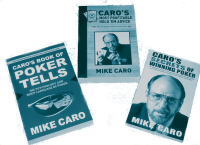 Poker1 library

Note: Not at the old Poker1 site. A version of this entry was first published (2007) in Poker Player newspaper.
Today I’m going to ask myself three questions about poker. I don’t know everything, so if I’m not capable of supplying an authoritative answer, I’ll say so. If I venture a guess, but I’m not certain the answer is valid, I’ll say, “I don’t know.”
Let’s get started…
Question 1: In hold ’em, is there a significant difference in value between a pair of deuces and a pair of sixes as starting hands?
Yes. It’s significant. Although most players tend to lump all small pairs into a single category and play them almost the same way, a pair of deuces is much less profitable than a pair of sixes. The most obvious reason is that if an opponent holds a pair of threes, fours, or fives, a pair of deuces is at a distinct disadvantage, but a pair of sixes has a commanding lead.
You might even end up making three of a kind when starting with two sixes and beat a smaller set of trips. With a pair of deuces, that’s impossible.
More powerful
But the difference is more powerful than that — and more subtle. A key consideration is that a pair of sixes might actually win a pot as a pair when a pair of deuces won’t remain a pair.
Let’s say the final board is K-K-4-4-9. In that case, if you hold a pair of sixes, you have meaningful chances of winning, often against a player who holds just an ace-high kicker and figures it might be enough to call with.
Yes, you can often bet that pair of sixes for value if the board looks something like the example. But with a pair of deuces, you have no hand at all, except what’s on the board — kings-up with a nine kicker. Your deuces not only don’t constitute a pair anymore, you can’t even outkick any opponent.
Rare escape
One remote possibility is that a six might be the higher kicker, if the board is — among many possible examples — A-A-10-10-3 or 8-8-7-7-4. This rare escape against a heads-up opponent isn’t possible with 2-2. It’s even possible that you’ll make a winning flush, if four suited cards hit the board, with one of your sixes used to beat an inferior flush.
This, too, is impossible with 2-2. Also, higher small cards are slightly more likely to make straights — and sometimes the winning end of a straight, rather than the losing end.
Often opponents will call when they pair the board below a six, especially heads-up. You have no such winning opportunity with a pair of deuces.
For these and even more reasons, you need to be aware that the bigger your pair is, the more profitable it is — and the difference is often beyond trivial.
Question 2: In hold ’em, is a pair of aces really worth much more than a pair of kings as a starting hand?
I keep hearing the words “aces and kings” used to describe the two giant starting hands you can be dealt in hold ’em. Players say stuff like, “unless you have aces or kings” or “with aces or kings I just call and lay a trap” or “I always raise with aces or kings to limit the field.”
It’s very dangerous to think of aces and kings as starting hands that are similar in strength. In truth, a pair of aces earns between 40 percent and 50 percent more, on average, in all situations combined in limit hold ’em. And, depending on the opponents, the difference can be even more pronounced in no-limit games.
It’s easy to understand when you think about it. Usually when you hold a pair of kings, you escape bumping heads with an opponent who hold two aces.
Tragedy
That rare tragedy cuts into your profit, too, but your main concern is that an opponent holds a single ace. That opponent now has five board cards pending to potentially pair and beat you. While that part is obvious to most players, the difference in profit expectation between the two hands seems surprising to them.
And let’s not forget to list some of the other negatives for a pair of kings: You can’t bet as confidently, as often, or as much as you can with aces; you might make the second-highest flush; you can connect for a straight that loses to an ace-high one; and still more.
So, don’t think of aces and kings as belonging to a single category. They are distinctly different hands.
Question 3: How likely is it that the best player in the world will win a poker tournament?
Not likely. First of all, who knows the identity of the best player in the world? I happen to think I’m the best player, but I’ll never be able to prove it, because I seldom play tournaments. For some bizarre reason, tournaments — where normal poker skills take a back seat to money-chasing tactics — have become the measurement of poker prowess. And thousands of players think they’re the best. This is probably a good thing, because it requires ego — coupled with skill — to win at poker.
Also, the difference in ability between the top tier of players is slight. I suspect that the difference is so small that the number one player could easily fare worse than the150th-best player, even if they sat at the same table for two years running. If the game went on forever, the small advantage would eventually make itself known, but that might not happen in a lifetime.
Pretty much equal
Essentially, the top 150 players are pretty much equal. And I just chose that 150 number arbitrarily. There’s nothing magic about it. The same concept would hold true if I’d said 300 or 20.
The notion that the top players are about equal is tough to sell to people who see some players winning many tournaments while others win few or none. But that’s how it is.
The concept is even hard to sell to myself, when I get my pride involved. I start thinking: Well, I know everything they know, plus I’ve actually done research they haven’t, plus I’ve focused on tells and psychology for 35 years! But there are probably others who have compensating skills of their own and — bottom line — there isn’t much difference in profit expectation among the best players.
Terrorizing tables
But, yes, some will win lots of tournaments and some will terrorize real-world tables for years. There’s a lot of luck involved in who gets hot and who doesn’t. That’s why you see some tournament superstars fade. It isn’t because they’ve “lost it.”
It’s because they never had it to begin with. There isn’t an it. There’s skill, which gives the best players a distinct advantage against lesser players. And there’s luck, which provides some players a random turn in the spotlight. That’s all.
Answer
So, now, I’ll answer the question. Suppose we could determine which player had a tiny advantage over the second-best player. That player is the best in the world. What are his chances of winning a tournament?
A great player has about three times as good a chance — in a typical affordable-buy-in tournament — of winning as an average player. In large-limit, spotlighted tournaments, attracting a stronger field, the advantage is usually less.
So, if there are 900 players in a “typical” everyday tournament, the best player in the world might win once in, say, 280 tries. As you can see, in the absence of luck, the best player in the world could go many years without winning a single event. That’s not a popular truth, but it’s the truth nonetheless.
Notice that, in answering these three questions, I rigorously stuck to my policy of simply saying, “I don’t know” anytime I wasn’t positive. — MC