



 Collections
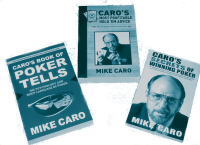 Poker1 library

Note: Not at the old Poker1 site. A version of this entry was first published (2007) in Poker Player newspaper.
You’ve heard me talk about today’s topic before, in various contexts. I’m passionate about it.
It has to do with the common notion that checking and then calling is weak. Many experts will tell you that professional poker players should keep their aggressive image intact by doing one of three things: (1) betting; (2) checking and then raising if bet into; or (3) checking and then folding if bet into. Checking and then calling is seen as a weak play – one that should be reserved for amateurs.
I disagree. Central to my teaching is the presumption that checking and calling is perfectly proper. This ancient lecture, one of my favorites, helps make the point…
The silly fear of checking and calling
Among the ranks of wannabe professional poker players and even among nearly world class players there is a notion that became popular 15 or so years ago. It’s a strange and silly notion that’s still going strong today.
It’s the notion that you should bet if you have a good reason, but if you don’t have a good reason, you should check. And that part’s fine – and obvious. But then the notion continues — If you check, this notion goes, you should then be prepared to either raise or fold if someone bets into you.
Let me rephrase that, so you understand what this popular piece of advice really says. Remember, it’s a common opinion that even many sophisticated players believe. The opinion is that when you check, you should seldom call if bet into. The related advice is that after you check you should either fold or raise. Checking and calling, they tell us, is a weak option.
Macho
A weak option? Oh, I get it, checking and calling is not macho enough, right? Get real, guys. Here’s the truth. If you’re one of those regular players in middle limit games who seldom checks and calls, you’re costing yourself thousands of dollars every year.
The truth is that checking and calling is the most natural thing in the world. Let’s reason this out together. When you hold a medium hand that’s not quite strong enough to bet with, what should you do? Should you throw your hand away out of turn because you’re frustrated? I don’t think so. Should you bet anyway, even though your hand isn’t quite strong enough? No. So, you should check, right? Right!
But then your opponent bets. Now what? According to the popular notion, you should rarely call.
Why?
If you were going to check and call, the notion goes, you should simply have bet in the first place. But why? We’ve just thought about it together and decided that our hand wasn’t quite strong enough to bet. So we did the sensible thing. We checked.
And now we’ve been bet into. All our options should still be open to us. We will usually fold our weakest hands. We will usually call with our medium hands. And we will usually raise with our strongest hands, assuming we planned our check-raise in advance as a trap.
Sure, there are exceptions. But if we don’t stick to the basic premise that we mostly fold our weak hands, call with our medium hands, and raise with our most powerful hands, we’ve just set poker science back a hundred years.
Exceptions
You see, poker science says that you can and you sometimes should be deceptive by playing a hand differently. But those are the exceptions. In order for deception to work, you must do the standard, unexceptional thing most of the time.
You need to check and call more often than you check and raise. If you’re checking and raising more often than you’re checking and calling – which is exactly what happens if you follow the popular “Don’t check and call” advice, your whole strategy is upside down and you’ll cost yourself money.
So, today I’m here to tell you that there’s nothing weak about checking and calling. Nobody’s going to think you’re a sissy for not raising. Your wife or husband won’t lose respect for you. The sun will come up in the morning. Checking and calling is the most natural thing in the world. When you have one of those very common hands that has medium prospects of winning, the thing you should usually do is check and then call.
Research
You see I’ve done my own analysis, programmed my own computers. Sure, I’m proud and I like to brag, but so what? I’ve actually done the research.
The point is there’s nothing weak about checking and calling. Despite what others say, that’s the strategy you should choose most often when your hand isn’t strong enough to bet. And I don’t just say it as a matter of opinion. I know it for a fact.
This is “The Mad Genius of Poker” Mike Caro and that’s my secret today. — MC