 Collections
 Poker1 library
Note: Not at the old Poker1 site. A version of this entry was originally published (2001) in the revived Gambling Times, called Win magazine.
Today, let’s talk about poker tells – mannerisms that give unintended clues to your opponents’ secret cards. Are poker tells real and important, or are they mostly imaginary? While many players who take tells seriously eventually become skillful in reading opponents, some have suggested to me that profitable tells don’t exist.
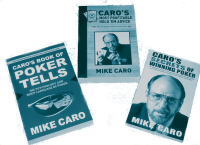
The main premise behind Caro’s Book of Tells – The Body Language of Poker is that you need to stop seeking tells that are particular to an individual. Sure, it’s possible that Martin looks at his watch, slaps his scalp, and grits his teeth every time he has three sixes. And maybe he does something completely different when he has a straight.
But, you know what? I think you could waste a poker lifetime looking for tells like those. They’re probably unreliable, even if you do spot them. There is no known psychological force that would cause Martin to look at his watch with three sixes and not with a straight. And even if it does happen, it’s most likely a coincidence and it won’t indicate the same thing next time.
Acting or not acting
But there really are tells that are extremely reliable. Before I explain a few of them, I need to explain my book further. It goes like this: Your poker opponents are either acting or they aren’t. Your job is to determine if they’re acting, and if they are, figure out what they’re trying to get you to do and disappoint them.
Fortunately, it’s not too difficult to read tells whenever opponents are acting. They’ll try to act weak when they hold strong hands and strong when they hold weak hands. That’s why you’ll sometimes see an amateur player shrug, sigh, and say, “I bet,” in a sad voice. That man almost always has a very strong hand. He’s trying to convince you that he’s miserable – so figure the opposite is true. He’s secretly gloating; he’s strong and expects to win.
One of the best facts about tells is that players go out of their way to act uninterested when they hold strong hands. So, instead of watching the action approach clockwise, they look the other way. Study the players who will act after you do. The key here is that players who have strong hands and are waiting to raise don’t want let you know this until you’re already in the pot. So, they make it seem safe for you to bet your money. Often they do this by looking away from the action. That’s usually a dead give away that you’re in trouble.
In fact, players who really are going to fold try to look interested. They’ll often stare at their cards, halfway reach for their chips threateningly, or watch the action approach with a false look of concentration. Why do they bother to do this when they’re going to fold anyway? It’s poker instinct. They’re in an arena unlike the real world beyond. In that real world, it’s OK to tell the truth most of the time. But if you do that in poker, opponents usually will know what you have. You’ve got to keep your hand a secret. So, players often act opposite of their true hands. Over and over. Again and again. Not every poker player does this, but many do, and once you see it, you can read that player time after time.
When they’re bluffing
What happens when a player is bluffing? Simple answer: That player usually becomes much less animated. He’s afraid that anything he does will seem suspicious to you and cause you to call, so he does nothing. Seeing a previously animated opponent bet and then become unmoving, scarcely breathing, is usually a sure sign of a bluff.
OK, so tells exist. But why do players have such trouble spotting them? I’ll tell you why. It’s because they’re trying to look at all opponents at once. You need to focus on one opponent at a time, because most tells are subtle and you’ll miss them if you’re trying to watch too many things.
Another problem is that players are expecting to see too many tells. I only see two or three sure-fire tells an hour, on average, plus many other lesser indicators. If you’re trying to see a tell every hand, you’ll imagine many that don’t exist, and this clutter will keep you from mastering the broader science of tells. And the worst thing players do who are trying to use tells is that they bring with them a bias toward calling. They want to be in action and make calls. So, they mentally manufacture tells that allow them to call and ignore actual tells that mean they should fold. You’re better off not looking for tells at all than to use them as an excuse to play poorly.
So, yes, tells are all around us. Everywhere. But you won’t see them every hand; you won’t see them at all if you’re looking at too many players at once; and they won’t do you any good if you’re not willing to obey tells that say “fold” as readily as tells that say, “call.” — MC