
 Collections
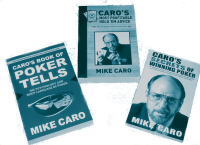 Poker1 library
Note: Not at the old Poker1 site. A version of this entry was originally published (2010) in Bluff magazine.
I’m about to discuss one of my biggest secrets to poker success. I probably shouldn’t do this, because if you play against me in the future, you’ll have an advantage. That doesn’t mean you’ll win; it just means that you’ll be less likely to become a victim of one of my meanest tricks.
When I say “meanest,” remember that I’m never going to appear hostile at the poker table. I believe in winning by showing love.
And love is an easy thing for me to show, because I genuinely feel it. All poker players share a common experience that isn’t well understood by most people. We’ve all suffered through nightmarish streaks of bad luck. We’ve sometimes wished our fate had been filmed, so we could prove our world-record bad streak. We’ve felt the joy of sudden surges in our bankrolls. We’ve enjoyed the uncertainty of not knowing whether financial pain or profit would greet us over the next 100 hands.
Share
We share that, all of it, all of us. So that makes us candidates to be friends. I nurture friendships at the poker table.
My goal is to seem bizarre, perhaps a bit unhinged. That’s my image.
But I always try to present it in a friendly way. I believe that players who seek attention by antagonizing or ridiculing opponents are costing themselves money.
Bad calls
How does that cost money? Can’t you badger opponents into making bad calls?
Sure. But players who use that tactic are sacrificing great long-term profit for a few quick dollars.
The reason is that even the weakest and loosest opponents have discretionary chips to invest. They’ll play weak hands sometimes, but not all times. They’ll also sometimes play even less profitable hands when they’re having fun and feeling comfortable.
Inspire
When you ridicule or irritate opponents, you make them uncomfortable. You inspire them to get even by playing better against you. That costs money. When you giggle and show love, you tempt them to play especially weak hands against you and you’re rewarded with many extra-special calls from hopeless hands. That earns money.
Anyway, I’ve done it again – rambled off the path. I hate it when I get sidetracked like this and can’t remember what I was saying. Oh, yeah, now I remember. I’m sharing one of my “meanest” tricks, but – as I was explaining – I don’t use the word “mean” here as a synonym for “hostile.” Hostility eats away at your bankroll.
The trick I’m talking about is simply to ask questions. Poker questions. The right poker questions at the right times. My motive is to elicit tells – and the technique works wonders. I’ll give you one simple example.
Destroy humanity
Get inside my brain and follow me.
I’m in a hold ’em game against Mahmoud Ahmadinejad who is the President of Iran. If I win this heads-up match, he has agreed to abandon all efforts to create nuclear weapons. If I lose, he will develop powerful nuclear bombs and destroy humanity.
Just to be clear, this heads-up match hasn’t really happened yet, as Ahmadinejad hasn’t yet replied to my proposal. So, this is imaginary. Sorry if you were getting nervous. When this actually happens, it will probably qualify as one of my top-ten most memorable poker matches ever.
Pretend
Anyway, let’s pretend. Ahmadinejad has moved all-in and I have him covered. I’m holding A♣ J♣ and the board, through the river, is A♦ K♠ 4♣ 3♠ 9♥.
I’ve studied this guy a lot and he likes to bluff. But is he bluffing this time?
Fortunately, I have a good way to find out. I turn my suited ace-jack face up on the table and try to gauge his reaction, while asking, “What would you do if you held this hand?”
The clue
Ahmadinejad, after a brief, breathless, and stunned hesitation due to the unexpected event, snorts with a hint of contempt. It’s as if to suggest, “Obviously, you should fold, but I’m not going to help you out.”
It’s the clue I needed. I call and he throws his cards away in disgust, surrendering the pot to me. But, as is my custom, I giggle to relieve the tension and show him love.
Realizing that I’m not trying to criticize his play or humiliate him, he smiles broadly. “Good call, Mad Genius. Israel is my friend now,” he declares.
Safe
The world is now safe, thanks to me. You can get out from inside my brain now and let me talk.
I frequently show my cards and ask that exact question when I’m against a single opponent who moves all-in. The surprising act forces him to know for certain whether he wants me to call.
Tells are harder to read against opponents who have doubt about whether their hands are positively best or absolutely beaten. By showing my hand, I’ve removed doubt and made tells more reliable.
The question
By adding the question, I’m forcing players to interact. If a response seems unworried, that’s almost always an act indicating weakness. If Ahmadinejad had actually held the winning hand, it would be only natural for him to feign concern – to pretend to be worried. That’s an attempt to coax the call.
Sometimes this ploy doesn’t work. I’m not always rewarded with the obvious tell I’m hoping for. In those cases, I’ll have to study more closely. The decision will be much tougher.
But my tactic gets the intended result more often than not. In fact, over the years, it’s been one of my biggest money makers.
In the case of Ahmadinejad that we imagined, there was no real money involved. That kind of sucks. — MC